In a large enterprise account, the answer is rarely obvious. A new executive joins. A division starts hiring for a capability your solution supports. A technology footprint changes. A competitor gains ground in one region while another business unit shows fresh buyer intent. Each signal may be visible somewhere, but the expansion pipeline is lost when those signals are not connected into a coherent account strategy.
For a Chief Revenue Officer or VP Sales, this is not just a seller productivity issue. It is a forecast quality issue. Existing customers often hold the strongest path to efficient growth, but only if the revenue team can identify whitespace, engage the right stakeholders, and align expansion plays to the customer's current priorities.
Why Manual Account Planning Misses Whitespace
Enterprise accounts are too complex for memory-based planning. A seller may know the relationship history, the current champion, and the open opportunity. But expansion requires a broader view: installed footprint, buying patterns, adjacent business units, executive priorities, market pressure, competitor position, and operational changes inside the customer.
Manual account planning usually surfaces only part of that picture. CRM history may show what has already happened, but not what has changed since the last deal. Public research may reveal hiring patterns, but not how they connect to your use cases. Buyer intent may signal interest, but it needs to be interpreted against the account's maturity and technology environment.
The result is an underdeveloped expansion pipeline. Sellers work the visible opportunity while hidden whitespace remains untouched. Leaders review forecasts that appear disciplined on the surface but lack the account-level intelligence needed to understand where growth could realistically emerge.
Q-Pilot Connects Opportunity History to Current Signals
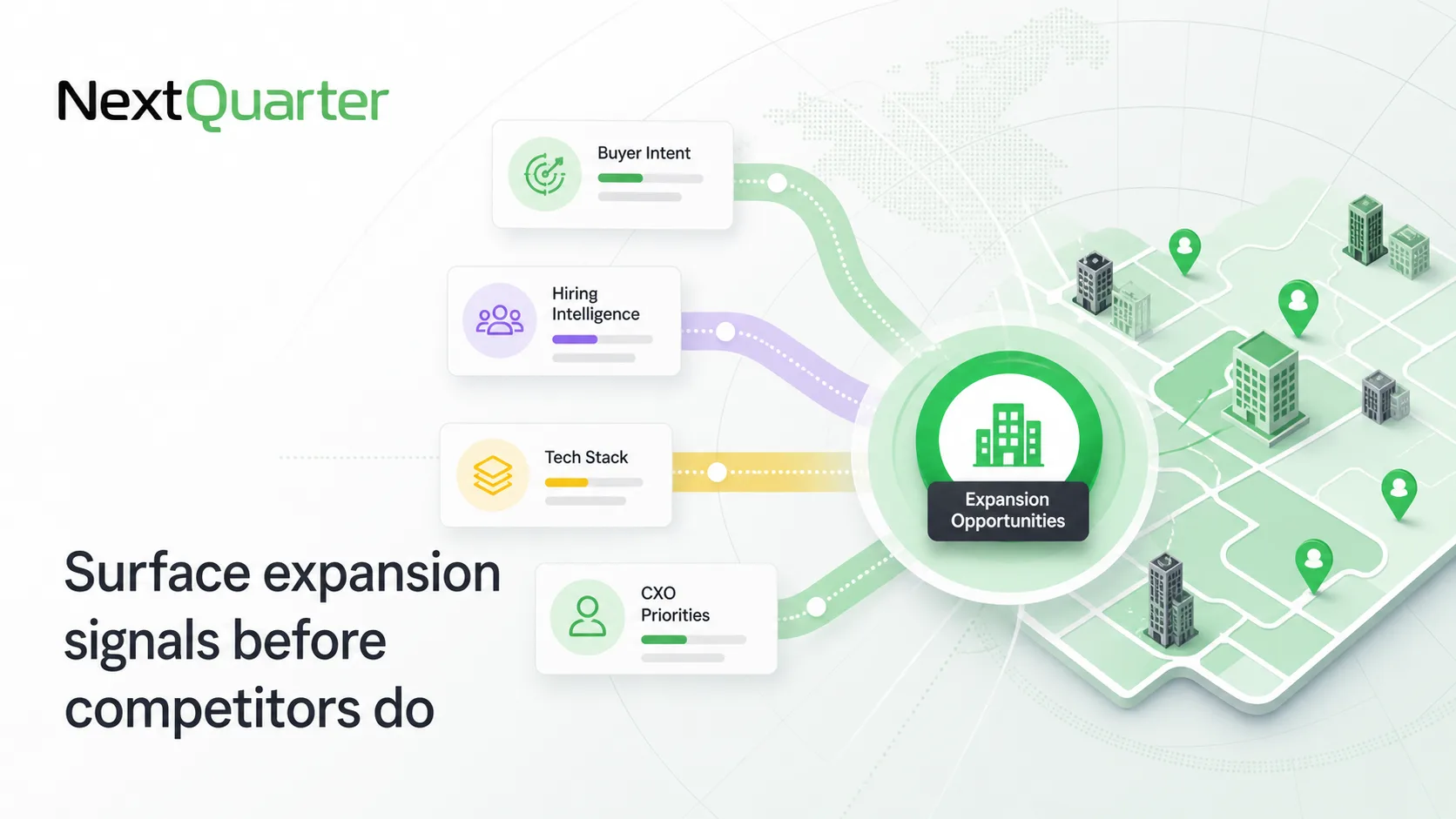
Q-Pilot is designed to help revenue teams see expansion opportunities inside known accounts. It uses opportunity history to identify installed footprint, infer whitespace, avoid repetition, recognize buying patterns, and align recommendations to account maturity. Then it combines that internal context with proprietary signals, including buyer intent, hiring intelligence, CXO profiles, tech stack data, and industry trends.
This is the difference between static account documentation and contextual intelligence. A seller is not simply reminded that an account bought something two years ago. Q-Pilot helps interpret what that history may mean now: which business unit may be ready for a cross-sell, which executive priority could open a new conversation, which initiative deserves a tailored pitch, and which stakeholder group should be engaged next.
For leaders managing expansion motions, this creates a more consistent operating rhythm. Account plans become grounded in the same categories of insight rather than the research habits of individual sellers. Pipeline reviews can shift from broad optimism to specific account hypotheses backed by current signals.
Proof: Existing-Client Opportunity Creation
In documented Q-Pilot customer-observed results, organizations saw a 144% increase in new opportunities at existing clients. That metric should not be read as a guaranteed outcome for every revenue team, but it shows what can happen when expansion planning is supported by structured account intelligence rather than manual research alone.
The mechanism behind that improvement is practical. Q-Pilot surfaces the account-specific signals that help sellers find new reasons to engage. Hiring intelligence may indicate a growing function. CXO profiles may reveal priorities that align with a strategic initiative. Tech stack context may point to integration, consolidation, or modernization opportunities. Buyer intent may highlight where interest is forming before a seller receives a direct request.
When those signals are connected to opportunity history, the account plan becomes more actionable. Sellers can see where they have already won, where they should not repeat the same message, and where the next logical expansion motion may sit.
What Revenue Leaders Gain Beyond More Activity
More activity is not the goal. Better directed activity is. Q-Pilot helps revenue leaders move from asking whether sellers are researching accounts to asking whether the right strategic opportunities are being pursued.
That distinction matters for forecast quality. Expansion pipeline built from vague account enthusiasm can create risk. Expansion pipeline built from named stakeholders, current business signals, historical buying patterns, and prioritized whitespace gives leaders a stronger basis for inspection.
It also improves coaching. A VP Sales can review why a seller is targeting a specific division, how the message maps to an executive priority, what competitor issue may appear, and which proof point should be used. The account plan becomes a living strategy, not a slide assembled before a quarterly review.