Finance has always been the function that turns numbers into business judgment. Every major decision eventually depends on a financial view of the business: revenue performance, margin movement, forecast confidence, cash flow, cost discipline, investment tradeoffs, and risk exposure. Over the last two decades, organizations have invested heavily in ERP systems, reporting tools, dashboards, planning platforms, business intelligence systems, and workflow automation to make that view more accessible.
Yet access to information has not always translated into clarity. Many finance teams still spend significant time collecting data, reconciling numbers, preparing reports, explaining variances, responding to stakeholder questions, and converting observations into recommendations. By the time the analysis reaches the business, the discussion has often moved to the next issue, the next forecast call, or the next executive question.
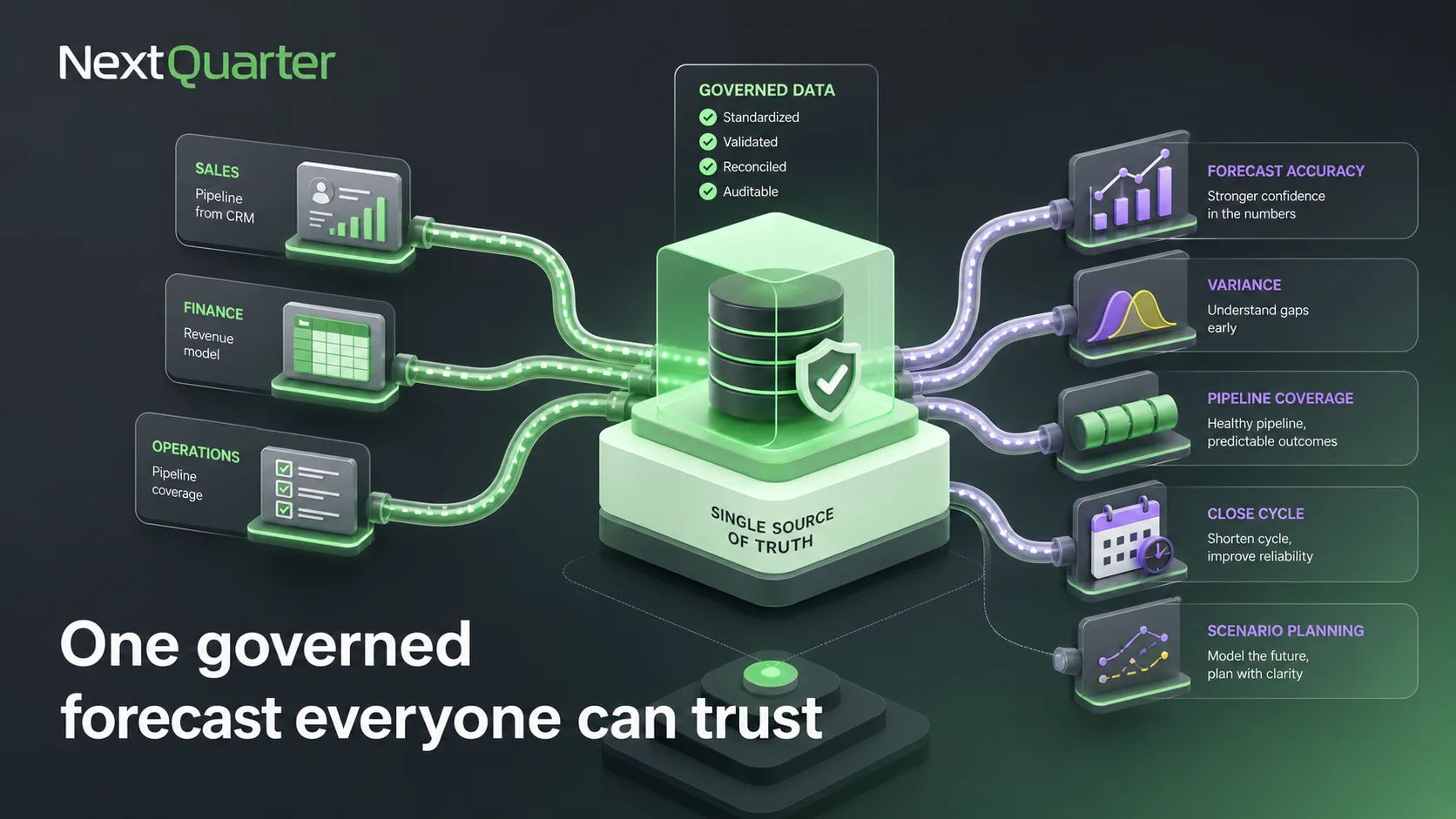
This is the gap that AI is beginning to expose in finance. The issue is not that organizations lack financial data. Most have more data than they can use effectively. The issue is that finance teams still need to convert that data into trusted interpretation, business context, and timely action. That conversion is where time, effort, and judgment are concentrated.
The next phase of AI for finance is not only about generating faster reports or answering isolated questions. It is about helping finance teams move from information to interpretation, and from interpretation to decision support. This is where Finance Agents become important.
How finance technology has evolved
The history of finance technology can be viewed as a steady movement toward one objective: getting the right information to the right person at the right time. Each generation of technology has improved that process, but each has also left an important limitation.
Reports helped finance standardize information. Dashboards made performance easier to monitor. Workflows improved process execution. Copilots made it easier to ask questions in natural language. Finance Agents represent the next step because they are designed to reason across information, pursue a business objective, and recommend action.
That progression matters because finance does not operate in isolated data points. A revenue miss is rarely just a revenue issue. It may connect to pipeline quality, customer delays, product mix, discounting, delivery capacity, sales execution, macro conditions, or changes in forecast assumptions. The value is not only in seeing the number. The value is in understanding what is behind the number.
Reports gave finance a common record
Reports remain essential to financial management. Monthly financial statements, budget versus actual reports, forecast packages, variance reports, and board materials provide a structured view of performance. They help teams align on what happened and create a formal record for management review, compliance, and historical analysis.
The limitation is that reports do not explain themselves. If revenue misses forecast, the report confirms the outcome, but it does not automatically explain the underlying causes. Someone still needs to investigate the drivers, compare assumptions, identify the business units or customers involved, and communicate what the number means.
Reports create visibility into historical performance. They are necessary, but they are not sufficient when the business needs a faster explanation of why performance changed and what should happen next.
Dashboards made information easier to monitor
Dashboards improved the speed and accessibility of finance information. They gave executives and business leaders the ability to track revenue, cash flow, margin, working capital, pipeline, expenses, and other key metrics without waiting for a formal reporting cycle.
This was a major step forward because it made finance information more visible across the organization. Business leaders could monitor trends, compare performance, and spot issues earlier than they could with static reports alone.
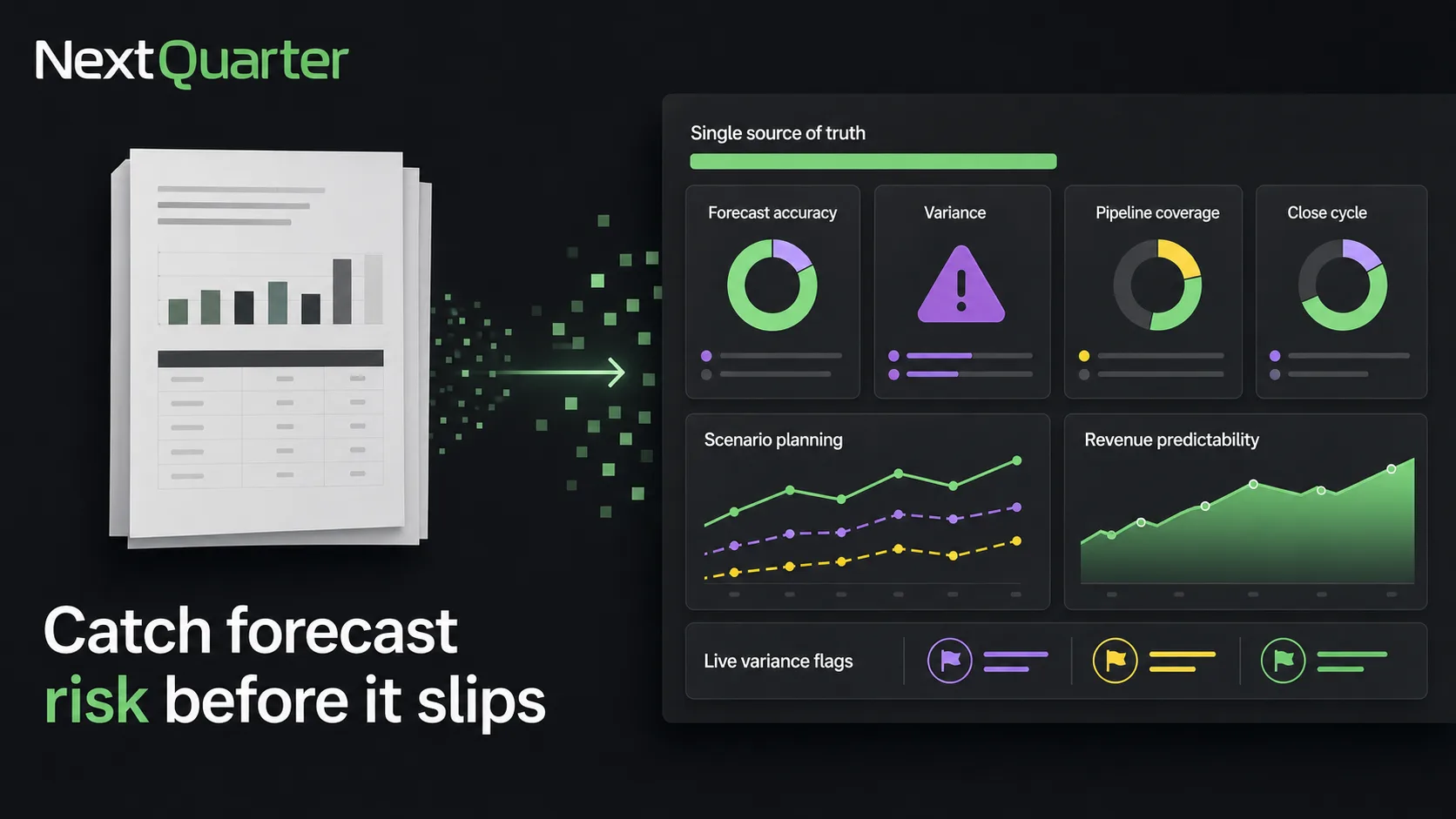
The limitation is that dashboards often show symptoms rather than causes. A dashboard may show that revenue is down, gross margin is under pressure, pipeline growth has slowed, or collections risk has increased. It may show where the issue appears, but it does not always explain why the issue is happening, which drivers matter most, and what response is most appropriate.
Finance teams still need to interpret the dashboard, connect it with other data sources, and convert it into a recommendation. Dashboards improve monitoring, but they do not remove the need for reasoning.
Workflows improved execution but not interpretation
Workflow automation helped finance teams bring more discipline to operational processes. Invoice approvals, expense reviews, forecast submissions, budget approvals, reconciliation tasks, and close activities became easier to route, track, and manage.
The value of workflows is clear. They reduce manual effort, improve consistency, create accountability, and help teams follow defined processes. For many finance operations, this has been an important improvement.
However, workflows depend on predefined rules. They can move a task from one person to another, but they do not always understand the business meaning of the task. A workflow can route an invoice for approval, but it may not explain whether the spending pattern signals a budget risk. A workflow can remind a business owner to update a forecast, but it may not assess whether the submitted forecast is realistic based on pipeline movement or recent performance.
Workflows help finance teams execute processes more efficiently. They do not, on their own, create intelligence.
Copilots made financial systems easier to question
The rise of AI copilots has changed how users interact with systems. Instead of navigating reports and dashboards manually, finance teams can use natural language to ask questions, retrieve information, summarize data, generate commentary, and explore performance.
This creates real productivity value. A finance leader can ask why gross margin declined in a quarter. An analyst can request a summary of forecast changes. A manager can ask for a first draft of management commentary. A copilot can reduce the time spent searching, summarizing, and drafting.
The limitation is that most copilots remain reactive. They wait for a user to ask the right question. The user still needs to know where to look, what to investigate, and how to judge the answer. The copilot may accelerate the response, but the finance professional still carries the burden of directing the analysis.
This is useful, but it does not fully solve the clarity problem. In many business situations, the most important issue is not answering a question that someone already knows to ask. It is identifying the question before it becomes urgent.
Finance Agents introduce a new layer of intelligence
A Finance Agent is not simply a better report, a smarter dashboard, a more automated workflow, or a more conversational copilot. It combines elements of each, but adds a different capability: the ability to work toward a defined financial objective.
A Finance Agent can monitor data, detect changes, analyze drivers, connect financial and operational signals, explain what matters, and recommend next steps. Instead of waiting for a user to ask a question, it can identify what needs attention and help finance teams understand the business impact.
In practical terms, a Finance Agent helps answer a broader set of questions:
- What changed in the business?
- Why did it change?
- Which drivers matter most?
- What is the financial impact?
- What action should be considered?
This is a meaningful shift. Finance Agents are not valuable because they add another AI interface. They are valuable because they help compress the time between a business signal and a finance response.
What this looks like in practice
Consider a familiar scenario. Revenue comes in below forecast. A report confirms the miss. A dashboard shows the impact. A workflow routes the update. A copilot can explain the variance when someone asks the right question.
A Finance Agent goes further. It can detect the variance automatically, analyze contributing factors, review CRM and ERP data, compare the forecast against pipeline movement, identify the accounts or segments responsible for the shortfall, assess whether the issue is concentrated or broad based, and recommend where leadership attention is needed.
The value is not just that the agent performs tasks faster. The value is that it brings context to the analysis. It helps finance teams move from a fragmented view of performance to a clearer explanation of what happened and what should be considered next.
Traditional systems present information. Finance Agents help interpret information.
The real challenge is clarity
Most finance organizations are not suffering from a lack of financial information. They are suffering from a lack of clarity at the moment decisions need to be made.
Finance teams are often asked to answer questions such as:
- Why did revenue change?
- What is driving margin pressure?
- Which forecast assumptions changed?
- Where are we exposed this quarter?
- Which customers, regions, or business units need attention?
- What is the likely impact on cash flow?
- Which explanation should leadership trust?
These questions require more than access to data. They require context, analysis, business understanding, and judgment. Historically, finance professionals have done this work manually by connecting information across multiple systems, validating assumptions, and preparing an explanation for stakeholders.
Finance Agents can augment this process by continuously performing parts of this analytical work. They can help surface issues earlier, organize the drivers more clearly, and provide a starting point for finance judgment.
This does not replace the role of finance leadership. It strengthens it. The objective is not to remove human judgment from finance. The objective is to give finance teams more time and better context to apply that judgment.
The shift from reporting to decision support
For many years, finance technology focused on organizing information and improving access to it. That work remains important, but it is no longer enough. The next phase is about decision support.
This distinction matters because the role of finance has expanded. Finance leaders are expected to do more than close the books and report historical performance. They are expected to help the business anticipate risk, improve forecast confidence, evaluate tradeoffs, support growth, and guide better decisions.
Executive teams want answers quickly. They want to know what changed, why it changed, what it means, and what should happen next. Finance Agents can help close the gap between available information and business action by continuously synthesizing data and surfacing recommendations.
The benefit is not only speed. It is focus. When Finance Agents handle more of the initial signal detection and driver analysis, finance professionals can spend more time shaping decisions, challenging assumptions, and aligning the business around the right response.
Where Finance Agents can create value
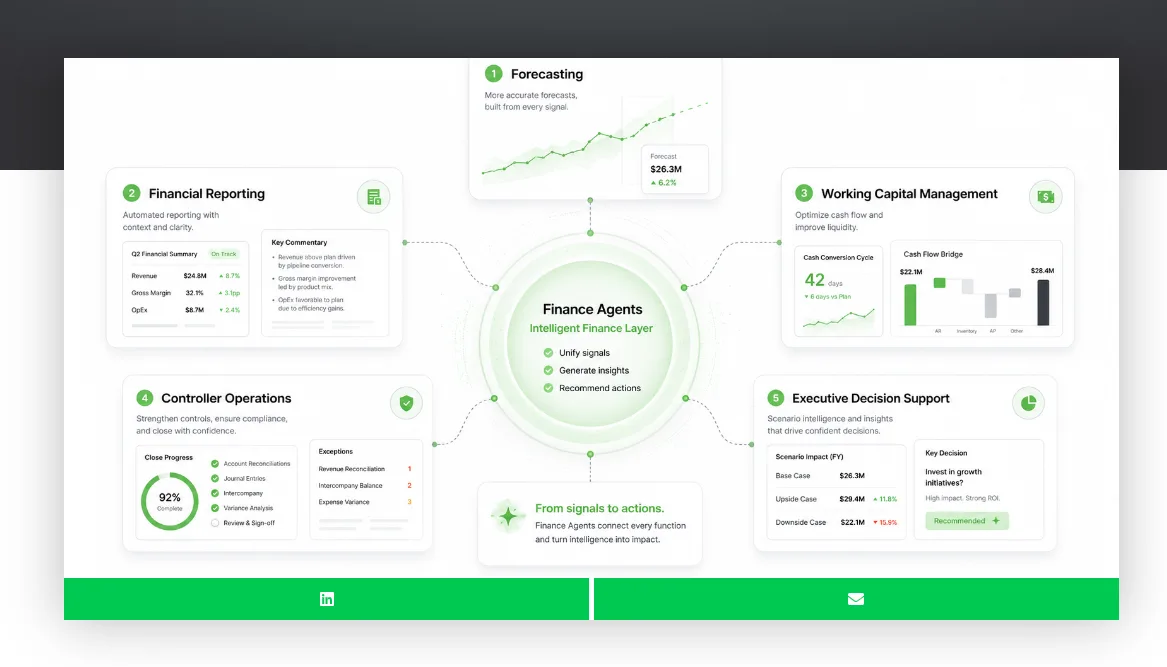
Finance Agents are most valuable in areas where teams spend significant time interpreting data, explaining change, and coordinating action. The opportunity is especially strong in functions where financial and operational signals need to be connected.
Forecasting
Forecasting depends on assumptions, trends, pipeline movement, historical performance, business judgment, and changing market conditions. Finance Agents can monitor forecast changes, explain variance drivers, assess confidence levels, and identify emerging risks before they appear in formal reporting cycles.
Financial reporting
Reporting is not only about producing numbers. It is about explaining performance. Finance Agents can help generate management commentary, surface anomalies, identify major drivers, and create a clearer narrative around performance changes.
Working capital management
Cash flow, collections, payment behavior, and working capital exposure require continuous attention. Finance Agents can monitor payment trends, identify collections risks, highlight cash flow pressure, and recommend corrective actions.
Controller operations
Controllers are responsible for accuracy, compliance, reconciliation, and close discipline. Finance Agents can help detect unusual transactions, identify reconciliation issues, monitor close bottlenecks, and surface compliance exceptions.
Executive decision support
Finance increasingly sits at the center of strategic decision making. Finance Agents can connect financial and operational signals, model scenarios, explain potential impact, and provide leadership teams with a more complete view of business tradeoffs.
What finance leaders should expect from this technology
Finance Agents should not be treated as another AI feature added to an existing system. In finance, trust is central. Any AI capability used by finance teams must be grounded in reliable data, transparent logic, clear ownership, and appropriate controls.
The best Finance Agents should support human judgment rather than bypass it. They should make it easier for finance teams to understand the source of an insight, review the reasoning, validate the recommendation, and decide the next step. They should also respect approval processes and audit requirements.
For finance, the question is not whether AI can generate an answer. The more important question is whether AI can help the organization reach a better decision with greater confidence.
That is why Finance Agents need to be designed around business context, not just language generation. They need to understand the objectives finance teams care about: forecast accuracy, margin performance, cash discipline, risk visibility, operational efficiency, and executive alignment.
Financial Clarity is the outcome
At Next Quarter, we believe the future of AI for finance is not simply about better reporting. It is about Financial Clarity.
Financial Clarity means that every stakeholder can understand what is happening, why it is happening, what it means, and what should happen next. It is the difference between seeing a number and understanding the business story behind it.
Finance Agents help create this clarity by continuously monitoring performance, interpreting signals, explaining outcomes, highlighting risks, and recommending actions. They become an extension of the finance organization by helping teams see earlier, explain faster, and act with greater confidence.
This is especially important as financial data continues to grow across ERP systems, CRM platforms, planning tools, spreadsheets, dashboards, and operational systems. More data does not automatically create better decisions. Without interpretation, more data can create more noise.
The opportunity for Finance Agents is to reduce that noise and help finance teams focus on what matters.
The bottom line
Reports tell finance teams what happened. Dashboards show what is happening. Workflows help processes move forward. Copilots answer questions. Finance Agents help connect signals, explain drivers, recommend actions, and support decisions.
That is the clarity gap in AI for finance.
The organizations that benefit most from AI will not simply be the ones with more dashboards or more automation. They will be the ones that can convert financial and operational signals into better decisions faster. In a world where finance teams are surrounded by more information than ever, the real advantage is not access to data alone.
The real advantage is clarity.