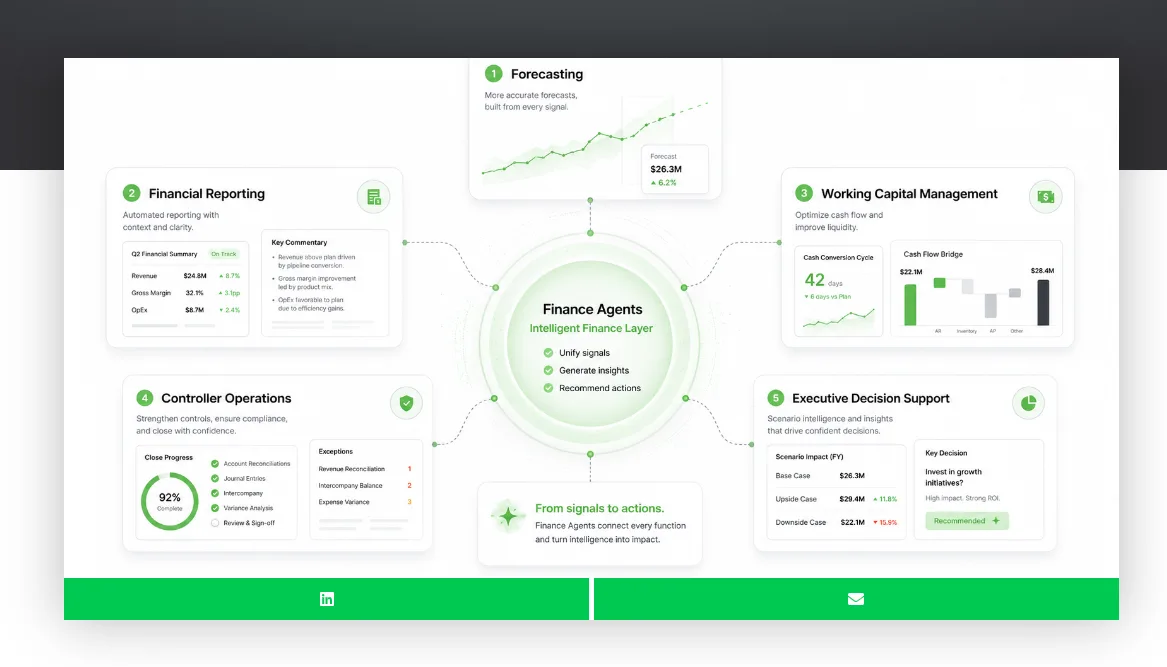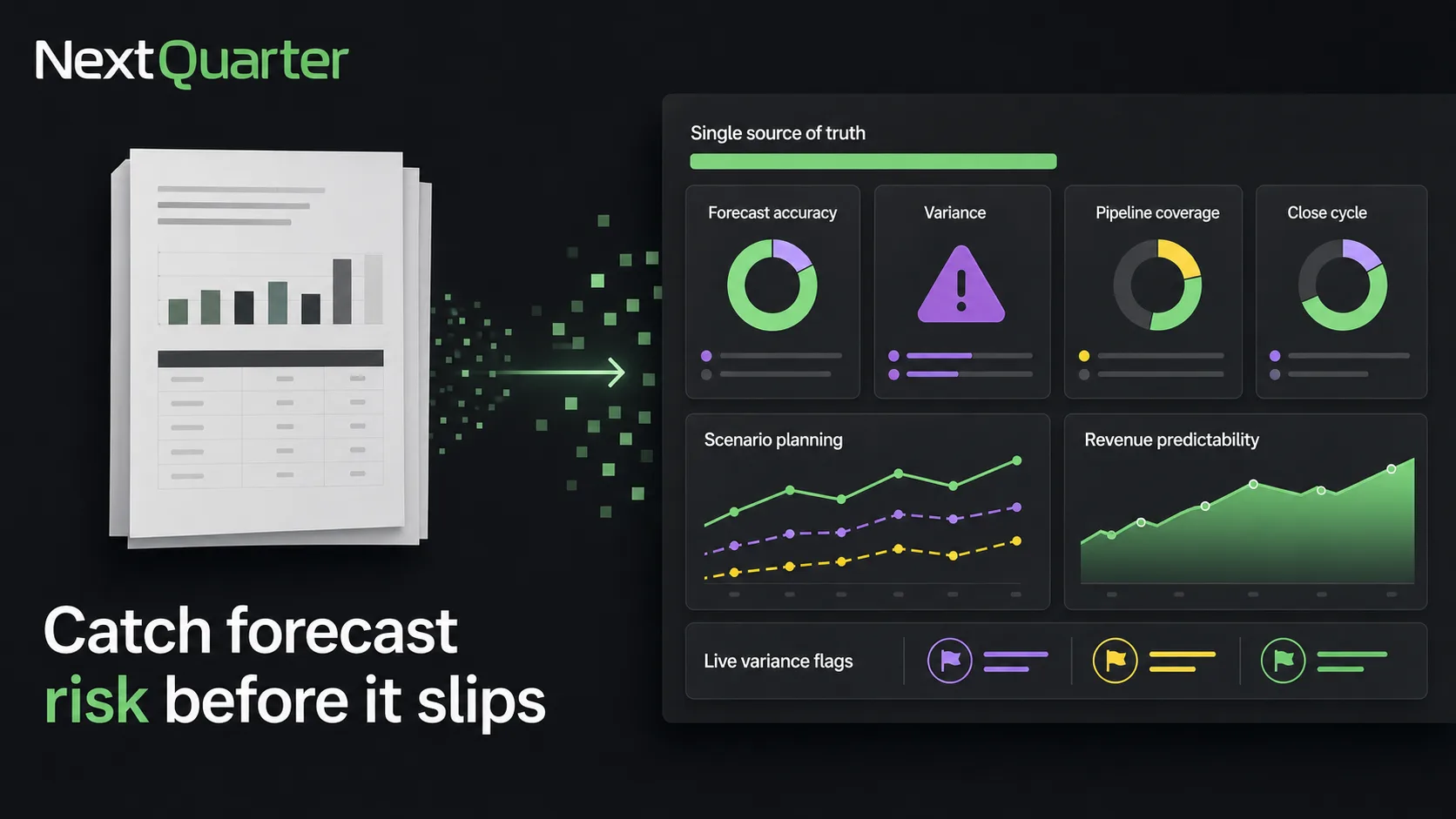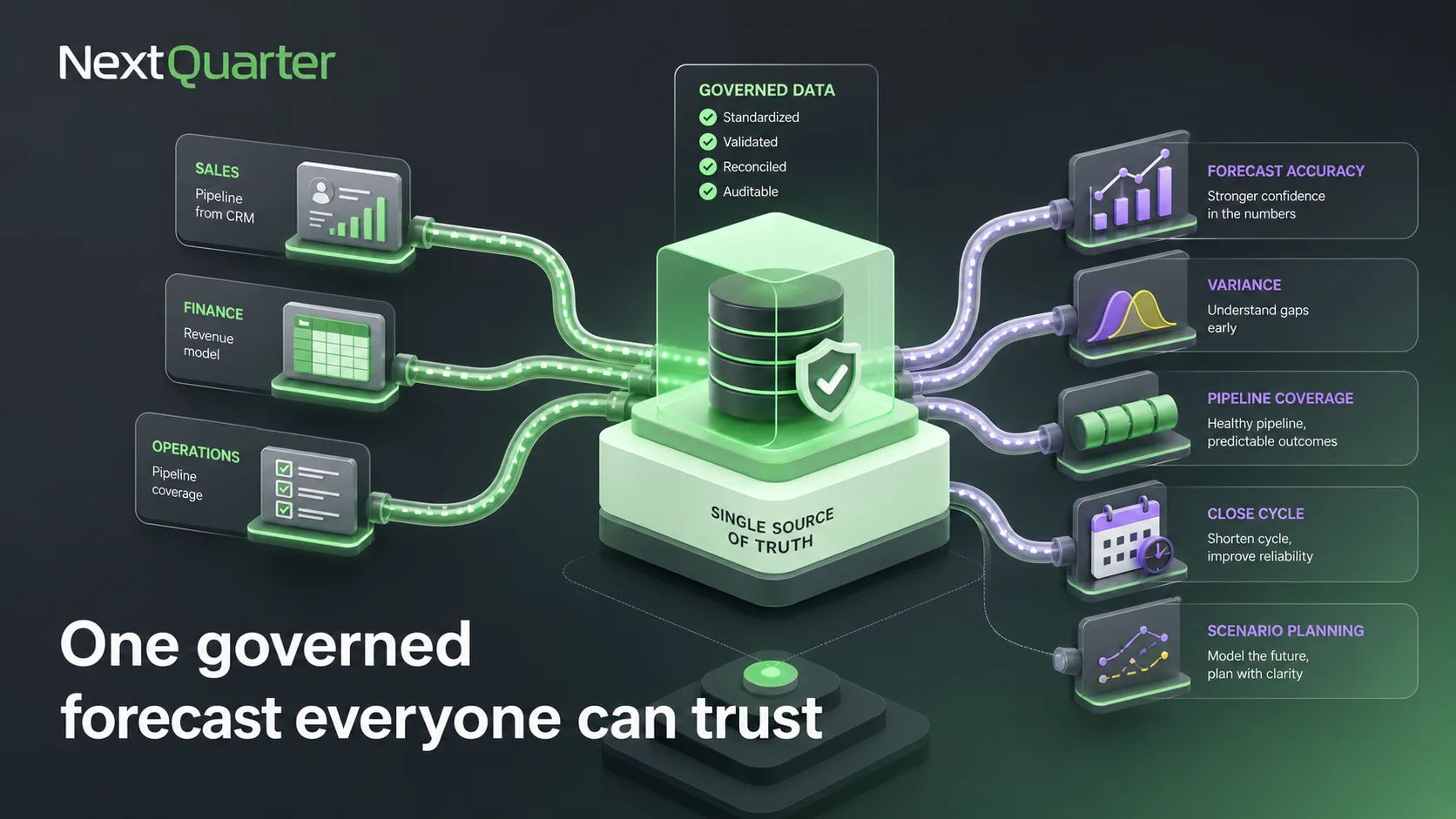
The problem is rarely a lack of effort. It is a lack of shared definitions, governed data paths, and ownership across the revenue forecast. Financial Agents from Next Quarter help revenue organizations replace fragmented forecasting with a single source of truth that connects CRM, live pipeline, finance data, and board-pack definitions.
Forecast Disagreement Usually Starts With Definitions
When Sales and Finance disagree, the conflict often appears as a number problem. In reality, it is usually a definition problem.
Sales may be forecasting based on opportunity stage, rep judgment, close date, and commit category. Finance may be translating bookings into revenue timing, applying different recognition logic, or adjusting for renewals, churn, and margin assumptions. Operations may be tracking pipeline coverage, conversion rates, and inspection hygiene. Each function is rational inside its own system, but the total forecast becomes fragile when the definitions do not reconcile.
That fragility shows up in familiar ways. A late-stage opportunity appears in the CRM forecast but does not map cleanly to revenue timing. Pipeline coverage looks sufficient in Sales reporting, but Finance sees risk because the mix does not support the quarter. A board-pack metric uses a definition that differs from the operating dashboard. By the time leaders discover the mismatch, the meeting has become a reconciliation exercise.
RevOps leaders sit at the center of this tension. They are expected to make revenue data useful across Sales, Finance, and Operations. But without governed source trails and shared logic, RevOps becomes the function that explains why the numbers do not match rather than the function that improves revenue predictability.
Financial Agents Bring Governed Logic to the Forecast
Financial Agents are purpose-built for the forecasting and revenue-planning motion. They are not simply a chatbot attached to the close process, and they are not another dashboard waiting for a static extract. They operate across live pipeline, CRM, and finance data to roll up forecasts, reconcile signals, and surface the logic behind the answer.
A key part of that mechanism is finance KPI training. NQ Fin Assist is trained on customer KPIs, definitions, data, and finance logic so outputs align to the way the business actually reports performance. That matters because revenue organizations do not need generic answers. They need forecast roll-ups and explanations that reflect their board-pack definitions, pipeline coverage rules, bookings logic, and revenue planning model.
Governance is equally important. Next Quarter's approach can expose sources, source queries, and SQL, allowing leaders to inspect how a forecast answer was produced. Every answer can be tied back to source data for review. For RevOps, that changes the operating posture: instead of mediating between competing spreadsheets, the team can point Sales and Finance to the same governed source of truth.
From Reconciliation Meetings to Revenue Operating Discipline
When Sales and Finance share a continuously current forecast, the meeting changes. Leaders can focus on deal movement, variance flags, pipeline sufficiency, and scenario planning instead of debating the mechanics of the number.
Consider a forecast call where pipeline coverage has fallen below the threshold needed to support the commit. In a fragmented process, Sales may argue the late-stage deals are strong while Finance questions whether enough revenue can land inside the quarter. With Financial Agents, the organization can inspect the live pipeline, connect it to finance logic, review the source trails, and model the impact of different close-rate or timing assumptions in minutes.
This does not remove judgment from the process. It gives judgment a better foundation. Sales leaders still understand account context. Finance still owns revenue logic and board readiness. RevOps still manages process discipline. But everyone is working from the same governed data layer and the same forecast language.
That is the practical path to revenue predictability. It is not achieved by forcing every team into one spreadsheet. It comes from connecting the systems they already use, training the finance intelligence on the definitions that matter, and keeping the forecast current as the quarter changes.